
BRIGHAM YOUNG UNIVERSITY HIGH SCHOOL RECOLLECTIONS A to Z
59 BYH Recollections

A to Z
Send in your most memorable BYH recollections for this webpage today. Simply start out by saying, "I remember..." and the rest is easy. We welcome your experiences in all subjects -- even on subjects where someone has already written something.

Allman's Field Trips
Teacher Verl Allman sometimes took his students on special field trips. As I read his autobiography on the BYH website, I have come to understand more about his drive to learn and teach. One of his most memorable trips was when he took the Jackson boys, Earl and Russ and myself and perhaps a couple of others on a drive to the other side of Utah Lake. Mr. Allman had been told where a rattlesnake den was, and he wanted to explore it. We were just naive enough and bold enough to want to also investigate it. Nearing a slate slide on the side of a small hill, we began hear the buzzing. Each step we took on the slate disturbed more and more of the vipers. No matter what we did, we could not get one to come out, but we did not try very hard to dig any of them out. We had a great picnic lunch and returned home with a greater understanding of the world around us.
He took us on another trip, this time to Aspen Grove on the back of Timpanogos. We spotted a squirrel, and through some ingenuity we managed to run it behind one of the big doors of the amphitheater at Aspen Grove. We then picked it up with a piece of clothing, put it in a box, and brought it back alive to the science room for display. One morning we found, to our delight, that the mother squirrel had given birth to a litter of hairless, blind, teeny, tiny babies. This provided us with another up-close look at Mother Nature, thanks to Mr. Allman. ~~Chuck Hackley '56
Anna B. Hart
I read Anna's Bookshelves. I know I am an emotional person, but the story really touched me. I remember "Anna" teaching me Literature. Most of my class members were not very interested in Literature. I found the subject fascinating. I remember her quiet patience, and the inflection she used when she read the Classics to us. She survived many "rolled eyes", and took it all in stride.
I think she inspired me to be a better communicator and writer. I am not at all surprised that her old house was full of bookshelves. I can personally testify to her love for literature. She was truly a teacher who helped BY High School to be a uniquely fulfilling experience for its students. ~~Kent Jarvis '60

The Beehive
I've tried to imagine what it meant for a student from rural Utah, Idaho, or Arizona to take a train to a small town like Provo and then walk up University Avenue. Most of our pioneer towns had quite remarkable meeting houses, a small number had stake academies, and there were impressive county buildings in the county seats. But few could claim an impressive educational complex like the lower campus. Students whose parents had instilled a hunger for learning must have felt like they had arrived at an educational banquet.
I suspect that one of the first things a student would have noticed about the academy complex was the old beehive fountain, built in about 1913, for this symbol of industry was a clear link between BYU and its supporting community. Well before the time I was a B.Y. High student, the beehive fountain had ceased flowing, but it seemed still to represent the ties we had with the past. Although we indulged in few philosophical reflections at the beehive (we were most excited when college homecoming queens came there to have their pictures taken), its presence in front of the old buildings was an emblem that transcended generations and tied our school to our culture. That culture placed more emphasis on education than any other culture in the West. ~~Todd Britsch '55
The Buildings
Anyone driving down Provo's University Avenue cannot help but be impressed with the Academy Building's almost literal rise from the ashes. But for those of us whose lives were shaped and directed there, the restored Academy Building evokes rich and plentiful memories of a time long past. Although it is now hard to separate the imagined from the real, to us this was a place of dreams, where our aspirations became fixed and where learning almost always seemed natural and inviting. The old buildings located at the square gave us a link both to founding experiences of the past and to the emerging greatness of the university. This link was so strong, in fact, that some of us never could leave the school we learned to love there (thus three of four recent BYU academic vice presidents were B.Y. High graduates). A good number of my classmates at B.Y. High went from kindergarten through their bachelor's degrees in schools that were part of BYU. I was a relative latecomer, entering the Training School in the fourth grade.
Because of the long association so many of us had with the school, the announcement that BYU would close its K–12 operation in the late 1960s came as a shock, and the subsequent sale in 1975 and crumbling of the buildings wrote a sad epitaph to a location that was once the vibrant center of a unique educational venture.
While we were students there, even the rather run-down character of many of the buildings added a surprising patina to all that we experienced, and the light filtering through the tall trees, especially in autumn, created a soft radiance in the place that we never forgot. ~~Todd Britsch '55

The Carrells
Several educational experiments were launched at BY High in the early 1960s. They involved reorganizing some curriculum to focus on individual rather than group learning.
This was introduced to the students as the "Go at your own pace" system. Two parts of this experiment were a "carrel study system" and a relatively short-lived Daily Demand Computer Scheduling (DDCS).
The second floor of the Arts building was gutted and replaced with a large study area filled with rows and rows of individual work stations called "carrels."
Students were given a certain amount of work in published workbooks, and required to complete it in a given number of months. Each carrel came with a switch which activated a light on top of the carrel. When a student decided he or she needed help, they switched on their light. Teachers were available, and came fairly quickly to quietly explain things when the published workbooks were confusing.
When a student completed a section and felt they understood the content, they requested a test. If they failed the test, they went back to review the unit. If they passed the test, they went forward to the next unit. Some students were able to progress and complete multiple courses. Students who fell behind the required pace were given the option to repeat, or finish the course by BYU Home Study Course.
The curriculum designers postulated that "independent students" would progress faster, and that "dependent students" would probably struggle. After some time passed, we were all surprised to learn that the opposite was true. "Independent students" rebelled at rigidity of the texts, the boredom of isolation, the lack of teacher-led classroom discussions, and the lack of alternative paths, while "dependent students" loved the cocoon provided by the closed system and its predictable outcomes. ~~Donna Lee Turley, BYH Guidance Counselor, 1962 to 1968
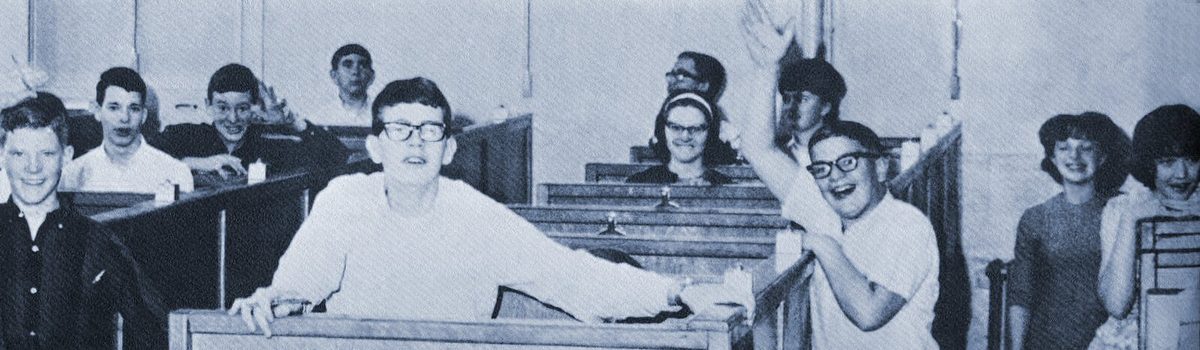
BYH Carrells, 1963-1964
More on the Carrells
When trying to share high school memories with my children, I tried to explain how the carrell system worked. I could never tell them without laughing. I always had to pull a BYH yearbook from the shelf so they could see and better understand. All the silly antics sure made learning fun. I remember Jerry Hintze sitting in the carrell next to me. I was slowly working my way through algebra and geometry, but I could hear him just whipping through the pages. How discouraging for me but great for him. Over the years when I have reflected back on my growing up years, I have attributed my strength and testimony of the gospel to the years I attended BY High. Finishing my last two years in a public high school in California helped me realize how much BY High has done for me. Thanks for remembering me! ~~Darlene Koralewski Brown '65
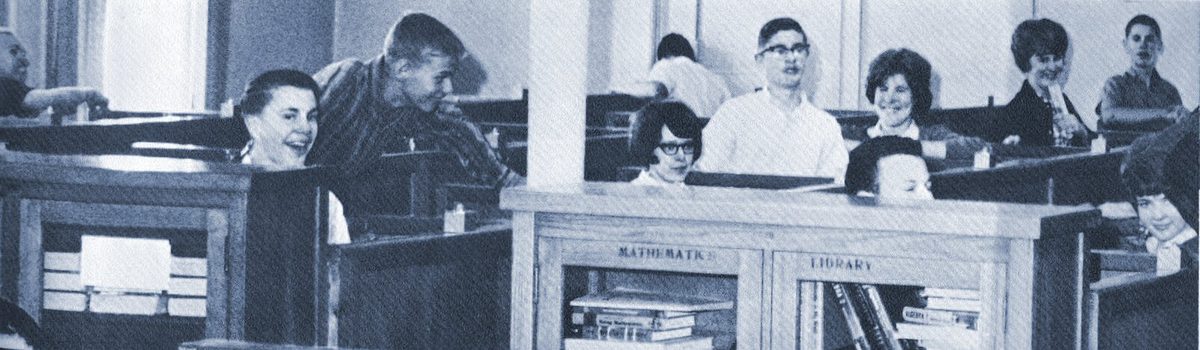
More Carrells, 1963-1964
The Catacombs
The most special places on lower campus, however, were those hidden completely from view. I never had quite enough courage to explore the heating vents that linked the buildings underground, but my companions described the experience in much the same way 19th-century novelists narrated daring escapes through the sewers of Paris. (I expect that most of these adventures were made of whole cloth, but our explorers made most of us believe that there were great mysteries here.) I did, however, have several labs in the space pushed out under the asphalt from the main science room. These spaces were universally called the "catacombs," and if we were particularly successful with our concoctions, we could approximate the smells of the catacombs' Roman namesakes. These labs were small and inadequate by any modern standards, but I've recently wondered if Paul D. Boyer, BYU '39, the BYU-educated Nobel Prize winner in chemistry, might have mixed his chemicals there. It is very likely.
One certain thing is that Philo T. Farnsworth, BYH '24, BYU '27, used space in the Education Building to undertake some of the early experiments that would later lead him to the invention of television. And when I think of Farnsworth and Boyer, along with a myriad of university presidents, scientists, political leaders, educators, entrepreneurs, musicians, Church leaders, and outstanding parents who received part or all of their training at the lower campus, I've wondered what special things were at work in this small, out-of-the-way institution. Somehow, the little college located mostly on the lower campus contributed far more than its expected proportion of outstanding graduates. ~~Todd Britsch '55
The Catwalk
I loved the catwalk. Every time we crossed it I wondered if it would hold us up. ~~Kristine Johnson Lee '65
I remember how much fun it was to stomp our way across the catwalk making as much noise as possible. ~~Darlene Koralewski Brown '65
There was a time when the ladies were too modest to climb the long stairs in the Arts Building because in so doing their ankles showed beneath their floor-length skirts, much to the glee of the over-aged elementary boys who hung around the lower halls to watch the event. The catwalk which connects the Education and the Arts buildings was the answer to this embarrassing situation. ~~Dr. Morris A. Shirts, Principal 1954-1956
Championship Basketball
When we graduated to the seventh grade we got to walk the halls with the tall and handsome basketball players. Basketball was big at B.Y. High. Even though our enrollment was small, we played as well as the bigger schools in the region.
I remember when the Wildcats won the state tournament. My family drove us to Salt Lake City for the championship game. I remember the smell of the sawdust on the inside track of the fieldhouse on the U of U campus. I don't remember whom we played, but I do remember the final score, 58–51.
Almost everyone from Provo stopped and had ice cream at Snelgroves afterward to celebrate. ~~Marilyn Monson Boekweg '67

The Closing
I left one year before it was announced that BY High would be closed, on a sabbatical leave to attend the University of Texas at Austin.
Before I left I requested a personal interview with three people: the Director of the Lab School (BY High), the Dean of the College of Education, and the Academic Vice-President of BYU, all of whom were in the chain of command involving BY High.
I sought assurance from them that BY High would not be closed and that I could continue to teach there after doctoral studies at Texas. All three said the crisis over whether or not BY High would be closed as had been rumored, was over, and that firm decisions had been made assuring its future existence.
I took it as a personal blow in December of 1967 when I was called from a class and summoned to the University of Texas College of Education office where I was instructed to get in touch with BYU officials immediately. Dr. Glen Ovard took my returned call and said he was notifying me that the next day the announcement would be officially made public that BY High was to be closed.
On paper BYU transferred me to the College of Education with the rank of Instructor, and carried me on leave for two more years hoping that I would return as a faculty member. Other opportunities became available which BYU could not match, so that was the end of my association with BYU. I am retired but currently serve as an adjunct professor of Spanish at Mesa Community College in Mesa Arizona. ~~Rex Arnett, BYH Spanish Language Teacher, 1962 to 1966.

More on the Closing
I came back to BYU High [from sabbatical leave in Africa] thinking: I have heard the expression, "I want to always want and I don't want to be satisfied with being satisfied," or some like expression, but I was perfectly happy here.
I love the school, the administrators, who were my personal friends, Lowell Thompson and Wallace Allred. I love the students, and I love Provo and my home on the hill. What more could one ask?
Everything seemed to be going fine, and then one Friday morning, December 8, 1967, we met in a special 7 a.m. faculty meeting along with the Elementary School faculty.
At this meeting, we were told that the BYU High School would be closed permanently at the end of the present school year, 1967-68. Some of the faculty were in tears, and others horrified at the prospect of trying to find another job.
Later in the afternoon, a special assembly of students was held in which they were informed of the closure. Again, many students were in tears, some of them having attended the school from kindergarten to their high school years. ~~Verl P. Allman, BYH Science Teacher, 1950 to 1968.
College Hall
A variety of educational activities took place on lower campus when I first went there in the years following World War II. The high school, originally an important part of Brigham Young Academy, was by then a relatively small laboratory school. Although the junior high was supposedly separate, grades seven through 12 shared facilities, went to assemblies and games together, and were, for most purposes, the same school. There was also a good deal of room sharing with those parts of the university that remained down below--much of the Music Department, some education classes, home economics, and a variety of others. As buildings were added to the upper campus, however, the high school took over more and more of the Education Building, until only College Hall housed any part of the university.
College Hall was connected directly to the Education Building (it was completed in 1898, only six years after the dedication of its companion), and it is impossible to think of them as separate. These two buildings housed many treasures. Perhaps my earliest memory of this area was of the wonderful glass cabinet that contained exotic fauna collected in Central America by BYA president Benjamin Cluff Jr.'s expedition, which set out in 1900 to discover the city of Zarahemla. Although the large snake was the most exciting creature in the case, we had the most fun trying to locate a tiny bird hidden among the flora. (For a number of years, before our chapel was built, our ward had its meetings in College Hall. I liked to be the one to take my little brother out of sacrament meeting because the display could keep me occupied for a long time.)

Although most performances of university and guest musicians had been moved to the Joseph Smith Building before I started attending concerts at BYU, College Hall was still the site of my first opera (Mozart's Abduction from the Seraglio, if I remember correctly), and it was the place we held assemblies, performed plays, and formed the B.Y. High community. Its stage remains fixed in my memory as a place of many exciting events. ~~Todd Britsch '55
Confetti in the Air
In the winter of 1962 or 1963, we really liked our history/social studies teacher, but she became ill for several months, so we were assigned a long-term substitute teacher. She was okay, though a little scatterbrained (I can't imagine why). We learned that some recent writing assignments we had turned in couldn't be found and so could not be graded -- we were a little frustrated.
Our Education Building classroom was the one that opened out on the seldom-used front porch.The temperature in that classroom was difficult to regulate, and the substitute often asked us to turn the thermostat up or down. She didn't like too much heat, because the radiator was at the front of the room just behind her desk.
One day one of our friends informed us that if we took a tiny pin and punctured the insulated cord going up the wall to the thermostat, touching both wires, it would turn the system on high. The radiator would get hotter and hotter, no matter how low the thermostat was set. The pin was almost invisible. We tried it a few times and it worked as advertised, but there was not much point in it -- it just made us all hot and uncomfortable, too.
Down in the old wooden floor was a large vent -- perhaps two feet by three feet -- covered with a metal grate. It was on our side of the room. The temperature could also be regulated somewhat by opening and closing that air register. One day we accidentally dropped some small candy wrappers down in the grate, and when it was opened the next day, the paper flew out like confetti.
This gave us an idea.
One day we put hundreds of tiny pieces of paper into the closed floor vent. Then when class first started, we stuck the pin through the thermostat wire. Predictably, the radiator began to really put out the heat. Our substitute personally manipulated the thermostat, but it made no difference. Everyone in the class was wiping perspiration from our foreheads.
Then the teacher remembered the floor vent. She asked one of the boys to open it to see if that would help. With his quick flip of the lever, the air in the classroom filled with tiny pieces of floating paper, like a snow globe that had just been shaken. "Snow" continued to fly up for about five minutes. Fortunately, the bell rang soon thereafter. We pulled the pin from the thermostat lead, and streamed out into the cool hallway, wet with perspiration but delighted that our plan had worked to perfection. ~~Larry Christensen '66

Dances in 250A
The dances in Room 250 in the Arts Building – what a delightful experience! The boys were all over on one side of the room, and the girls were all over on the other. Each of us was trying to be cool, yet get more of us involved so we could actually have a dance without being out there all alone. Our teachers did their best to make all sorts of games of it to encourage us, and a few students would catch the "fever" and actually go out and dance on that creaky old wooden floor.
And from a bashful young man's standpoint, Sadie Hawkins Day dances were particularly fun! To actually have a girl ask us to go to a dance -- it was a real eye-opening experience. I won a pie that first year when I was asked to the dance by Kay Johnson, and boy, did my mother chew me out when I brought it home – she was upset because I did not give it to Kay. Oh, the pain and lessons I learned while growing up! I hope Kay has forgiven me. ~~Chuck Hackley '56

Early Release Program
Anna B. Hart was one of our older teachers. We did not know much of anything about her, except that she had been a teacher at BY High for a long time. I didn't hear her unusual life story until long after I graduated. I knew only that she was proud of being very "efficient" and was determined that we would become "efficient" too.
One year my class took a reading course from her -- actually an "SRA" reading lab -- that involved systematically reading through an endless number of cards, then answering questions about what we had read. Each reading and test was carefully timed to teach us to read faster and more efficiently. It was actually a very helpful program.
When class started each day, Anna B. Hart did something I have never seen any other teacher do. Without fail, she called one of the students to come forward, and handed them her portable classroom clock. She asked the student to go down the main hall and synchronize this clock with the official school time.

We instantly recognized this as an opportunity, and whoever served as time-setter for the day always set the classroom clock 10 minutes ahead, consistently releasing us early.
For years we have chuckled over getting out of her classes ten minutes early every day. It has only recently occurred to me that Anna B. Hart was a very intelligent lady, with decades of classroom experience with scheming students. She probably knew exactly what we would do, thus releasing her from class early every day, too! ~~Larry Christensen '66
Election in 1956 for Student Body President
In the Spring of 1956, David Grow and Ken Bentley were running against each other for election as Student Body President of BY High. The winner would serve during the 1956-1957 school year.
In an age before communications technology had been applied to our school political campaigns, Dave Grow did something remarkable that proved he was way ahead of the game.
After their campaign really started to heat up, early one morning everyone arrived on the Lower Campus to find four huge letters dangling from the bottom of the catwalk. The letters spelled, G R O W.
This was not an easy campaign feat to top -- maybe impossible.
Grow took a lead in the campaign, largely on the strength of the giant letters he and his friends had somehow managed to wire to the frame of the catwalk.
Of course, several major risks were involved.
For example, the heavy letters had been suspended in the dark of the night, hung higher than any ladder I had ever seen, and they had to be firmly secured to keep them from falling on someone.
Most dangerous of all, the deed had been done without the permission of the school administration.
Surviving all risks, Grow managed to emerge as the winner. ~~ Nick Boshard, '61

The Environment
Transferring from a predominantly non-Mormon school, I loved coming to BY High where I would hear conversations in the hall, lectures in class, or as we gathered around the main hall, about Mutual or Seminary. It was so nice to be around peers who shared the same values I had.

To not smell smoke or alcohol in the classrooms and halls, to have teachers who were examples I could look up to, and to be around peers who could have so much fun doing good things, was such a refreshing change from the school evironment from which I had come. ~~Shirlee Davis Packer '65

False Fire Alarm
One day fire engines came roaring up to BY High, the school bells rang an alarm, and we evacuated all of the buildings. This all happened because a couple of the guys, who were sitting on the front window sill of room 250A, decided to yell “Fire!”
We thought it was so neat to see all the commotion, but, alas, the administration took a dark view, and conducted an intensive search for the culprits. I do not think they ever found out who did it. ~~Chuck Hackley '56
Filibuster in Seminary
At BY High, all of the students took Seminary classes. The classes were held at various times during the day -- thank heaven we had no early morning or Saturday classes. Many of our classrooms had a piano of some type in them, making it easier to schedule a Seminary class there. Seminary classes almost always started with a prayer, a scripture reading, and a hymn.
One day our class was scheduled for a big exam in Bro. Wallace Montague's Book of Mormon class. There had been a lot going on in our other classes that week, and everyone had found it difficult to study for this test. We were all desperate to avoid that test, but how? Mr. Montague never gave in when we begged for mercy.
Larry Denham suggested a plan, and in desperation we decided to try it. After a normal opening prayer, Mel Martin led us in a hymn he had selected -- A Poor Wayfaring Man of Grief -- all seven verses of it. Mr. Montague looked at his watch a couple of times as he sang along with us, but did not say anything. When our singing finally ground to a halt, Mel slowly returned to his seat.
Then Larry came forward and began to read an entire section of the Doctrine and Covenants -- one of the long ones. As he read verse after verse after verse, we began to see -- this is the truth -- smoke slowly curling out of Mr. Montague's head! He was a large man, and suddenly he could take no more. He stood up and sent Denham to his seat.
"I realize what you are doing, folks," said Mr. Montague. "I had already planned to delay the test until next Monday, but I had hoped to spend today helping you to review for it. Mel and Larry, I'm sorry to interrupt your musical and scriptural filibuster, but we need to get on to things that are more important. Okay?"
With fresh enthusiasm we began to cram for the exam to come. ~~Larry Christensen '66
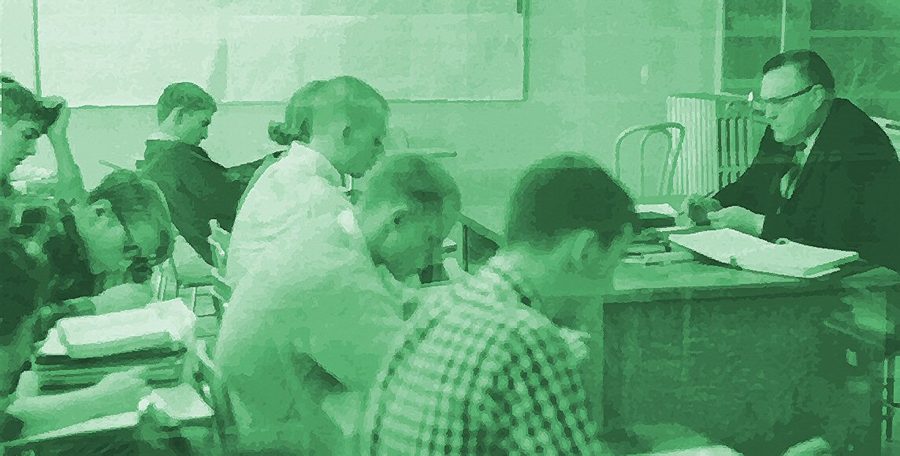
Bro. Montague's Class Thru One-Way Glass
Fire Escape
We loved the College Hall fire escape--a long spiral slide that was attached to the north side of the building. The fire escape was a constant concern to our principal and teachers. It was such a great temptation that several people suggested locking the door to the slide. But locked fire escapes don't make fire marshals very happy. Instead, a variety of threats were used, with varying degrees of success. Since I, one of the more shy and reserved members of my class, can remember numerous great swirling descents, I expect that the rules against using the fire escape were observed mainly in the breech. ~~Todd Britsch '55
First Aid
One day Dean McDonald fell through the window of the science room and cut his calf muscle nearly in two. David Payne '62 calmly administered first aid by holding the muscle together. It was the noon hour, and since David did not know how long it would take for help to arrive, he went ahead and ate his lunch with one hand while holding Dean's leg together with his other hand. ~~Alec Andrus '61
First Friend at BYH
As I started down the path through six years at the BYU Training School and B. Y. High, the very first friend that I met was David Meldrum. In the fall of 1951, I met him in the Maeser Building on Upper Campus while signing up to pay my fees. He was there with his father and we struck up an acquaintance that has lasted a lifetime.
David Meldrum lived in Edgemont way up the Provo Canyon road. He did not graduate with us in 1956 because he transferred to schools in Layton in the 10th grade. However, he made an impact on many of us because of his special attributes.
David lived on a farm, and knew the impact and value of the many labors necessary to make such an operation work. He rode a ten-speed bicycle almost every day from all the way from Edgemont to school and back. Can you imagine anyone doing that today?
He never took any work home. He did all his homework during class or during the noon hour, and he received almost straight A’s!
The only time I remember him getting into trouble was in Mrs. Gilbert’s English Literature Class. He and I were very frustrated with spelling. David decided, like George Bernard Shaw before him, that words should be spelled just like they sounded, and so proceeded to turn in his homework with that system. He soon learned that "the system" was not designed for such "outside of the box" thinking, and was reprimanded and straightened out.
I have noticed that I can learn something from just about everyone I meet in life. One of the important things I learned from David was, “Nothing is impossible – just improbable.” I spent many hours trying to think up impossible things in life, but he could always come up with a solution. His powerful thinking has allowed him to accomplish much in life, and through his example, allowed me to accomplish much in life, too. ~~Chuck Hackley '56


Gassed in 1956
One day in 1956 a couple of the guys, including Stuart Biddulph, slipped into the old furnace room and made a batch of rotten egg gas. The fumes drifted throughout the main building, and we all got to leave classes early. We thought it was great. The administration, I am afraid, took a dimmer view. I don’t remember the consequences, but would be interested to know more of this story.~~Chuck Hackley '56
Gassed Again in 1957
One warm day in 1957 I remember watching my classmates pour rotten egg liquid into the heat vent during Problems in Democracy Class. This resulted in evacuation of the building for a little while. ~~Kent Jarvis '60 More
Gold-Plated French Dictionary
At BY High I was required to take a class in French from a genial young teacher named Thomas Patten. He tried hard and was so understanding, but I never even learned how to look up a word in my new French dictionary. He assigned all of us to write a poem in French -- an unmitigated disaster for me. However, Mr. Patten insisted that I enter my gibberish in a BYU language festival, held one cold Saturday on the upper campus. I had to read it aloud; it was embarrassing beyond words.
I knew I was going to get the first "F" of my life, and then would have to repeat the class! My friends were doing a little better, but they were sympathetic. In fact, one of them even came up with a strategy to improve my grade. I laughed when I heard it, but eventually did it out of sheer desperation, and perhaps it worked.
In art class, we had access to various materials, including gold paint. It was used to paint the edges of books, like many of our scriptures, to make them shine like gold. The plan was to paint my entire French dictionary in gold, let it dry for a few days, and then on the last day of class present it to Mr. Patten as a token of appreciation from our class, for "getting us started on the golden road toward speaking French like a native".
I got a "C" and did not have to repeat the class. Some say the gold-plated dictionary had touched his heart. I suspect he passed me so he would not have to see me back in his class again the next year.
P.S. Later I went on a mission to Taiwan from 1967 to 1969, where after tremendous travail I began to speak Mandarin Chinese. I had higher help, I know. But where many of my companions promptly forgot all of their Chinese upon returning home, I had had to work so hard to get it into my mind, it has been impossible to forget it, though now 36 years later, it is a little rusty and fu tza. ~~Larry Christensen '66

Honky-Tonk Hymns
One day after school, some of us were sitting around in Anna B. Hart's empty classroom, just talking. One of the students sat down at the old piano and began to play a song, practicing for our Seminary class, which came second period the next morning.
Suddenly one of the keys he played produced an odd tinny sound. We opened up the piano lid and discovered the problem: someone had stuck a thumbtack into the felt of one of the hammer heads.
Quickly we scrounged around and came up with a box full of thumbtacks. Soon we had converted every hammer in the old piano by adding a thumbtack. Our piano player then played five or six songs in this delightful style. We had never known how the distinctive sound of an old honky-tonk piano had been made -- but now we knew. It was delightful to hear anything plinked out, including hymns, in this old-fashioned style.
When we were ready to leave for home or practice, we began to remove the tacks, but our piano player had a better idea. Our second class the next morning was Seminary, and there was no class scheduled in this room during the first period.
"Let's leave the tacks in," he said. We agreed.
The next morning all of the culpable parties arrived a little early, for once. Our pianist quickly took his place at the piano bench to prevent any premature disclosure.The student who would lead the music was one of us.
We started off with our usual opening prayer, scripture reading, and hymn. Although we knew what was coming, we were still shocked by the tinkling sounds:
"Let us oft speak kind words to each other…"
[The musicians feigned a surprised stumble or two, but recovered nicely and continued soberly to the end. The rest of us worked hard, with only moderate success, to avoid laughing.]
"At home or where'er we may be;
Like the warblings of birds on the heather,
The tones will be welcome and free…"
At the long hymn's conclusion, our Seminary teacher congratulated our chorister and pianist for continuing on despite the "flabbergasting sounds" that had emanated from our piano.
After that, however, we noticed that he personally checked the hammers on the piano before each and every class, to avoid any more honky-tonk hymn playing. ~~Larry Christensen '66
Hooky
One day Kathy Brady and I decided to play hooky from English class, and we walked north up the University Avenue to a candy store.
When I was sitting in Mr. McConkie's History class later, the principal, Mr. Nelson, came into our class and called my name. I was so embarrassed and scared.
He went with me into Mr. McConkie's office, sat down in the teacher's chair behind the desk, put his hands behind his head and leaned back, giving me the evil eye all the while.
Remember those old rickety desk chairs? He lost his balance and fell backwards onto the floor -- I had a hard time keeping a serious face! ~~Susan McNamara Comish '66


Idea Starters

Jubilee Celebration
I remember a Jubilee Celebration when we joined with all the college students and marched down Academy Avenue (father of University Avenue) to the Provo Tabernacle. All the students sang, "Stars of Morning, Shout for Joy," and it was one of life's biggest moments. ~~Dorothy O. Rea '29~H
Junior Prom

I recall with fondness our entire Junior year, especially preparations for, and pulling off, the best Junior Prom ever. O the leaky fountains, and those paper flowers on the white-washed trees! I remember being with several classmates on the day after the dance, sitting around the church cultural hall, in the midst of all the dance decorations we seemed not to have the will to begin dismantling. I think we wanted that moment to last forever. I guess it has. ~~Mike Bullock '65

Kennedy Assassination Remembered
It would be nice if I could replay some of the funny times we had while in school, but the most vivid memory of our years together was brought back during the attack on the Twin Towers that occurred on that infamous 9/11. That incident reminded me of the same terrible feeling I had during the lunch period on November 22, 1963, when the Kennedy shooting was announced. In my mind's eye I can still see that many of you stopped eating your sack lunch as the horror of national terror and death unfolded. The normal activity of trying to attract attention to ourselves was overshadowed by the silence in the room that followed the announcement of that terrible event. Fortunately, as we have seen, life goes on even after tragedy. I continue to be grateful for our shared background that formed the foundation for my life. ~~Greg Wilson '65
Kennedy Assassination in Real Time
I was teaching Spanish at B. Y. High School on lower campus when someone yelled in the hall that President Kennedy had been shot. It came like a thunderbolt of shock and grief I had heretofore only felt once -- at a death in the family.
It was 11:45 a.m., November 22, 1963, and of course I can recall exactly where I was standing on the third floor of the now-razed Arts building, threading tape into a language laboratory recorder. I hurried home a few blocks away at noon and followed the news until I had to return to teach afternoon classes, then rushed back to continue the watch.
Even those unborn at the time have seen all the same scenes in stark black and white. But there was something about seeing them live. As subsequent events unfolded most dramatically, only those who were living and old enough to remember them can appreciate what it was like to see all this, as we say now, "in real time."
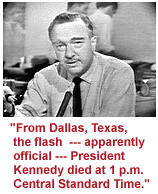
We witnessed the previously unperturbable Walter Cronkite emotionally confirm the President's death, and the somber scenes of Dallas and Dealy Plaza. Then there was the still photo, aired just minutes after the event, of Judge Hughes, the Johnsons, and the bloodstained Mrs. Kennedy at the swearing-in of our new President aboard the Presidential aircraft.
Everyone in the community was aware of President Ernest L. Wilkinson's political preferences and that he detested Democrats. However, none of us, regardless of party affiliation, expected anything less than the total closure of the University on Monday, January 25, 1964, in observance of the funeral of President Kennedy.
We were startled and shocked at the decision made by President Wilkinson to proceed with classes as if it were an ordinary day. Following his decision, announced on Sunday afternoon or evening, there were rumblings of discontent, but muted (though not completely), as the vast majority of faculty and students were not in agreement. However, we, for the most part, respected authority and prepared to report as usual.
I called my colleague at B.Y. High, Julia Caine, who taught a course in History in the room next to my Spanish class, during what was to be the funeral hour. I told her I would bring my small TV to her larger room if I could bring in my Spanish class. She readily and with appreciation agreed.
The epilogue to this story is unfortunately an ugly one and may not survive editing because it reveals a darker side of prejudices and carrying out policies to an extreme. President Wilkinson, in announcing that BYU would hold forth as usual on the day of the Kennedy funeral, did encourage those free of duties or class during the funeral to watch the proceedings on TV.
So Julia Caine and I had no qualms about merging our classes (after all, hers ironically was the Current History class), with my portable TV set up. We and our rapt students followed the caisson, the riderless horse, and the remainder of the cortege across the Potomac to Arlington.
Just as the proceedings there began, an assistant administrator at the Laboratory School, apparently rankled that I had moved my class, poked his head in Mrs. Caine's room and berated me and all of us for not following the university policy of no cancellation of classes.
He then jerked the electric plug and carried off my TV to his office. I shed no tears some months later when he was removed from his position, but I smoldered the entire time over this high-handedness. ~~M. Rex Arnett, BYH Spanish Teacher 1962-1966

Locker Room Building
I remember the days when all of the boys had to run up to the old BYU stadium for gym class with Coach Jed Gibson. Our lockers and showers were located in an old wooden building, and the coach had an office there. One day Gibson was interviewing us one at a time about grades or something, and when my turn came I left the field where we were doing track stuff, and went in to his office. As I went inside I passed an old door that was nailed shut. It divided the locker room hall from another locker room on the other side. I could hear talking and laughter on the other side of the door.The voices were female. I moved down the hall to the office. After the business in the office, I came back out into the hall. I was all alone and couldn't help but notice that the door had a small hole drilled in one panel. I could still hear the girls talking. I went toward the door with every hope of enjoying the scene on the other side. Just as I put my eye to the hole, Coach Gibson's voice came roaring out of his office: "Get away from that door!" The timing was perfect. I jumped away from the door and ran outside to send the next victim in. ~~Paul Nibley '65

Lower Campus
My memories of Academy Square neighborhood cover a lifetime and are linked to some of the most enjoyable periods of my life. I grew up living across the street from Academy Square on First East. To us it was always known as the Lower Campus, and we played on the lawns on the south and west and among the buildings. An abiding memory from those days is the sound of music that poured from the practice rooms in the basement of College Hall on the east half of the block. We played our games to the accompaniment of endless scales and practice compositions. We attended B.Y. High School in the Arts Building on the northwest portion of the block, and additional classes were held in the other buildings. Plays and weekly assemblies were held in College Hall. The Men's Gym on the top floor of the Training School Building on the northeast part of the block included such features as a great pole to slide from the dressing rooms down to the gym floor, exercise ladders, and a ping-pong table in a caged area above the gym. ~~Dick Boyle '48

Men's Gym in the 1950s
Our family lived near the Lower Campus from 1946 through 1957. During our free time in the summers and on many weekends we could usually be found playing basketball in the Men's Gym.
This old gym and its dressing rooms took up the entire third floor in the BYU Training School building. It came complete with old brown leather basketballs that harkened back to the turn of the century.

B Y Men's Gym, 1902~1968
While the gym was officially off limits to students who were not engaged in physical education classes or team sports, my friends and I started to devise many different ways to enter the gym.
For example, we would hide in the lockers until regular practices were over and then take over the gym for hours of basketball. This became kind of an unsanctioned neighborhood league.
In addition to my brother, John, and myself, the other members of our basketball group included Gary Smith, Dee Kirbey, Dickie Mangum, Allen Dixon, and Gary Johnston and Bruce Johnston, who were brothers.
The fifties were a great time to live around the Lower Campus where a kid could still be a kid and not be labeled a hoodlum for simply wanting to play basketball.
~~ Nick Boshard, '61
Mom, Is That You?
Some friends and I came up with the idea of using the lines in the BY High language listening room to access the outside telephone system. We constructed a box identical to the regular switch box, determined where the telephone lines were, and so forth.

In the advanced stages of this project, it suddenly dawned on us that, during school hours, everyone we might wish to talk to was already AT SCHOOL. Had we put together an ingenious system capable of making calls from the Language Learning Center, only to call someone's mom? ~~Randy Peterson '65

Nights in the Summer
I remember many warm summer nights cruising Center Street between 1956 and 1960, my BY High years. The neon signs from the stores bathed the sidewalks and streets with their soft multi-colored light, mysteriously changing the colors of our cars as they moved up and down Center.
Sometimes there was also drag racing out on the dump road. We added up and compared the points on our driving records, and stood by our cars talking for hours. Later we met at the High Spot Drive In for unforgettably delicious hamburgers, malts and fries. I have not forgotten playing lots of pool with my friends, sneaking into drive-in movies by hiding in the trunk, and dancing to live Rock 'n Roll music at the Apollo Outdoor Dance Hall in American Fork. The Apollo had no roof, so we could look up and see the stars while we were dancing. When we purchased a ticket, they stamped one of our hands with a florescent stamp so we could leave and return periodically by showing our stamp under an ultraviolet light near the door.
We wore flat-tops or duck tails, and the girls wore pony tails. The girls dressed in long skirts and sweaters, and the boys wore T-shirts and jeans, and sometimes turtle-neck sweaters. Black leather jackets were fairly common. Leather shoes were the norm -- sneakers had not yet become everyday footwear. Quite a few boys wore button-down dress shirts and nice slacks, sometimes with unbuttoned light-colored sports coats -- but no ties.
For some reason I recall a special moment idling my car while waiting for the train to pass by at midnight, with the radio on and that "special girl" -- back then -- sitting close beside me. Maybe it was the scent of my Elsha or Old Spice aftershave, the scent of her perfume, the hardtop windows rolled down, the dice dangling in the front window, the perfect pin-striping on the dashboard, the rolled and pleated white leather seats, the throaty sound of a V8 engine resonating through opened chrome lake plugs, or the hauntingly beautiful sound of "One Summer Night" by the Danleers playing on the car radio? Then came "Smoke Gets in your Eyes" and "Enchanted" by the Platters; "All I Have To Do Is Dream" by the Everly Brothers; and "Mack the Knife" by Bobby Darin.
And I still remember the sound of my hubcaps hitting the driveway concrete as they were being stolen in the dark at 3:30 a.m. That was the way it was on a summer night when I was at BY High school. I know some people say they would not want to re-live their teen-age years. I have no regrets -- I had a "riot" being a kid! ~~Kent Jarvis '60 ©


Opportunity in 1892
Howard R. Driggs was seventeen years old when he came to Brigham Young Academy. This was the last year it was held in the Z.C.M.I. warehouse. He came in contact frequently with Dr. Karl G. Maeser, who both awed and inspired him. In 1892 Howard achieved a Normal [Teaching] Diploma and a firm resolve to be a teacher.
Howard Driggs later spoke to our student body in College Hall, recalling the march of joy and anticipation he had with the entire school from the Z.C.M.I. building to the new Education Building on 5th North in January of 1892.
His word pictures were so vivid we actually saw the parading band, and the Grand Old Flag in front of an organized group waving flags and singing their way to new heights in education. The Board of Trustees, the faculty, the college classes, high school, elementary grades including kindergarten, and townspeople followed in buggies, surreys and wagons.
A glorious dedication followed in a large, high-ceiling room, to be known as Room D, crowded to the window sills, with people filling the adjacent halls. A new home, a greater opportunity and challenge. "We left that room with religion in our souls," Driggs concluded. ~~T. Earl Pardoe, BYU Faculty 1919 to 1952.

Pigeons
Like most other students at BY High, I was almost oblivious to the existence of the many pigeons that made their home on the Lower Campus. They never picked fights, and only rarely bombed you with a splash of white poop. One day in 1965 the BYU grounds crews began to spread salt-peter saturated corn kernels on the roof and on the sidewalks around the school. We were told that their purpose was not to kill the pigeons but to cause them to "shun one another" -- that is, to reduce the future pigeon population.
However, when dead and dying pigeons began to appear on the sidewalks, the students became concerned. The pigeons, accustomed to light rations, suddenly had more food than they had ever seen before in their lives. They overate, had trouble flying, and when they fell from great heights, the fall often injured or killed them. In response to student protests, the BY High administration stopped the population control program, and the grounds crews swept up and discarded the drifts of corn kernels. ~~Larry Christensen '66
Problems In Democracy Class
One warm day in 1957, we were gathered together in our "Problems of Democracy" class, being taught by a tall, imposing and articulate man in a suit, Mr. Don L. McConkie ("McConk" to us students).
This class was held in the Arts Building, and we were sitting at small desk-chairs painted white, with black speckles in the paint. It looked like paint job number seven or eight.
Just as Mr. McConkie began discussing the finer points of the United States government, I heard unusual activity in the row of students behind me to my left. I turned around just in time to see a fellow student and his accomplice pour a yellow liquid from a small glass vial into an air conditioning vent in the wall near the floor. The vent was blowing cool air into our warm classroom.
Within about ten minutes, our classroom and the entire Arts Building began to smell very strongly like the sewer. As students will do, we started coughing, noisily dramatizing our distress. We began to sink to the floor, as if being overcome by the "toxic fumes".

Soon a janitor appeared and said something to our teacher. Mr. McConkie quickly evacuated us from the building. Every window in the building was opened. We stood together on the front lawn, gasping and coughing dramatically in the fresh air. After thirty minutes or so, it was determined that the sewer had not backed up into the building, and that the building was aired out sufficiently to allow classes to continue. However, our "Problems" class period was over, so we went on to our next classes.
Of course, I knew what was in the glass vial. Bob’s Army & Navy Store, a fascinating store in downtown Provo, sold small glass vials of "rotten egg gas" -- along with real Army surplus clothes, helmets, canteens, and many other novelties. I don't know what legitimate military role was served by rotten egg gas, but for civilian teenagers its chief function was to "gas" your friends when they least expected it.
History tells us that the two boys who pulled off the Rotten Egg Gas Attack of 1957, became honorary alumni of BY High. "Honorary alumni" are students who attended BY High but did not graduate therefrom, having transfered to another high school prior to achieving Senior status. I do not know if this malodorous incident served to prematurely facilitate their honorary status. ~~Kent G. Jarvis '60

A Quiet 'Moment' After A Storm
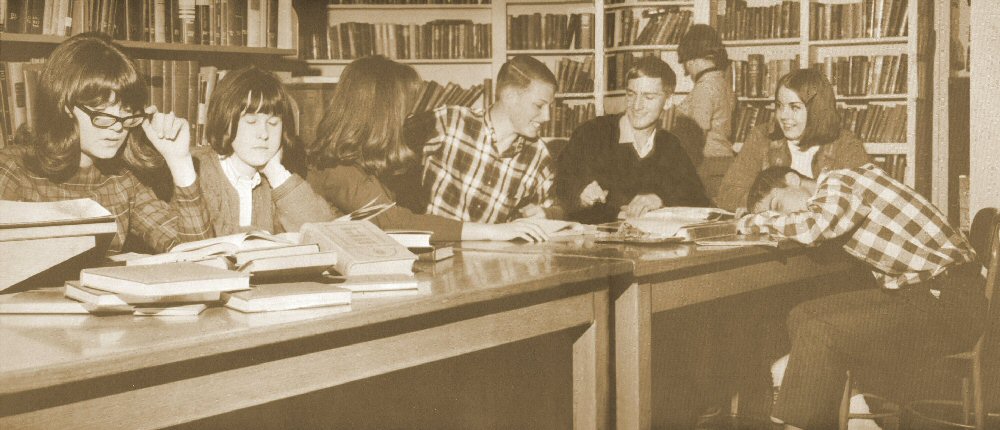
One thing I loved about BY High was that our library kept its doors open long after classes were out for the day.
I had tranferred to BYH from a school where the library was locked up tight as soon as the last bell rang at 3 p.m. To use it you had to get a teacher’s permission to miss part of their class – and they didn’t like that.
The BYH library wasn’t exactly a good place to hang out with your friends because June Berry, the librarian, ran a tight and quiet ship. But it was a peaceful place to study and do homework.
My family lived in Springville and my mother worked in Provo, so I rode to school and then home with her each day. However, she didn’t pick me up after school until 5:30 p.m., so I had several hours every afternoon to talk with friends, read, do homework, work on the newspaper, or roam around the Upper Campus.
I also spent a lot of time working out in the George Albert Smith Fieldhouse, usually running on the indoor track, then watching Stan Watts conduct BYU basketball practices.
One afternoon while we were in classes it rained, but the downpour stopped before classes ended. It was quite warm and nice outdoors, and the sun was beginning to light up the storm clouds. But I needed to study, so I went into the BYH library. I sat at a table near the back windows. These windows looked out on the interior courtyard of the school, and on the back of the Training School.
Sitting at the large table with me – I remember as if it were yesterday – were Neil Riddle, Linda Christensen, Roger Sheffield, John Boshard and Brian Bergren. The tall old-fashioned windows were open, and we were enjoying the invigorating fresh smell after the rain.
Two of our classmates, Bariann Trunnell and Vicki Ballou, were outside on the playground in the swings near the windows.

You'll Never Walk Alone
There were a lot of kids out there, mainly younger elementary students. Bariann and Vicki began to sing one of my favorite songs, a hauntingly beautiful piece from the Rogers and Hammerstein musical Carousel. In perfect harmony, they sang:When you walk through a stormAs they sang all of the verses, those in the library who could hear them turned to listen, and even the kids on the playground paused what they were doing. When Bariann and Vicki finished their song, there was total silence.
Hold your head up high
And don't be afraid of the dark.
At the end of a storm is a golden sky
And the sweet silver song of a lark.
Walk on through the wind,
Walk on through the rain,
Tho' your dreams be tossed and blown.
Walk on, walk on with hope in your heart
And you'll never walk alone,
You'll never walk alone.
Neil turned around and said, “Now, that was a moment.”
We went back to what we were doing. But I have never forgotten that time when we heard extraordinarily beautiful music on what was otherwise an ordinary rainy day. ~~Larry Christensen '66
The Sounds of Silence

Roll-Over
One night the BY High basketball team was returning home from a basketball game in a bus. In the canyon below Moroni, they saw that some girls in a Volkwagen had skidded on the icy road and it had rolled over on its roof. The entire team jumped out of the bus and turned the car back on its tires. The car miraculously started, and the girls drove down to Spanish Fork, with the bus following behind just in case it happened again. ~~Alec Andrus '61


Saratoga
Located west of Lehi on the north shore of Utah Lake, Saratoga was a delightful swimming facility that included indoor and outdoor swimming pools, along with picnic grounds and other recreational developments. Springs gushing from the ground made it all possible. The area was not necessarily the most lush, but it was clean and fun. The swimming and diving and just horsing around was what life should be all about for teenagers. And then there was the eating and talking and camaraderie -- it included everything needed for good memories.

...and the Theme from Moulin Rouge
Hope is the perfume of life. Hope for a better day … hope for a brighter future … hope for happiness and success. On one trip in 1955, when we were juniors at BY High, the blossoming of the fairer sex and our notice of them was in full splendor. One memory that I will always hold clear and dear happened when I was watching as several of our young women classmates came forth from the women’s dressing room at Saratoga dressed in their "one-piece" almost-completely-covered swimming suits, just as the music echoed in that large indoor swimming pool enclosure – and the song they were playing was The Theme from Moulin Rouge. Do you remember the song? Whenever I hear it carries me back to that moment in time. ~~Chuck Hackley '56
Snowballs & Jim Petty
Through most of my elementary school years, I was generally known to my teachers as a calm and studious boy. But I concealed a secret that few people had ever witnessed. On rare occasions, when I was sufficiently provoked, I could lose my temper and fly into an uncontrollable rage.
This problem limited my ability to play contact sports because when I lost it, I also lost physical coordination and my ability to reason. If I was in any sort of a fight, I usually got beaten up. To me the natural violence in football and basketball always diminished my dexterity.
One winter day in 1963, I was walking outside the Arts Building toward the Education Building, when I was struck hard on the back of my head by a snowball. Ice scattered down into my books and papers. I whipped around and discovered exactly who the culpit was: Jim Petty! I literally saw red.
In total rage, growling and gnashing my teeth, I dropped my books and chased Jim fiercely with every intention of breaking him into pieces. Jim ran away from me, but when I closed the gap to about fifteen feet, he looked at my face, pointed at me and began to laugh. "I've never seen you like that," he gasped, helplessly convulsed.
I was completely disarmed by his reaction. From that day to this, I have never experienced one of those total blind rages. Thank you, Jim. Except for you and your sense of humor, I might have ended my life locked in a cell at the Point of the Mountain, or worse. ~~Larry Christensen '66
Slingshot
In about 1953, as part of a Halloween Party, somone strung an aircraft carrier "catch-cable" from two Ash trees in front of the Arts Building. We sat in a makeshift seat and were flung into the air by the makeshift slingshot! What fun! ~~Chuck Hackley '56
Student Teachers
I was one of those fortunate students who attended B.Y. High. I began my education there in the fourth grade. I felt so proud to attend the Brigham Young University Elementary Laboratory Training School. We got a kick out of using that elongated title. I think my class had a reputation for being rowdies. The guys had fun sneaking out of windows during class, and the girls weren't afraid to go down the outside fire escape during gym class, on the third floor of the Lab Building.
I particularly remember the student teachers. While I was in the fifth grade, as a joke on us, one of the sixth grade boys dressed up as a girl and sat with a real student teacher at the side of the class. We couldn't keep our eyes off him. She was weird, but we'd had weird ones before. When he finally revealed himself, we were angry for being deceived.
But the all-time best student teacher story was from chorus class. When a particularly gullible young man was asked to direct the class, we claimed we couldn't see, so we asked him to stand on a chair. We told him, "Mr. Webb always stands on a chair when we can't see him." (Mr. Webb wasn't very tall.)
Eventually we got him up on the grand piano, and he was leading us from that perch when Mr. Webb entered the room. The student teacher was embarrassed, Mr. Webb was aghast, and yet we all had a good laugh, especially because the student teacher was quite tall in the first place. ~~Marilyn Monson Boekweg '67

Teaching at BYH, Early 1950s
During the early 1950s teaching at BYU Laboratory School was no picnic. My varied assignments and preparations meant that I had to work hard. We had some students that had been expelled from other schools who came to BYU High School and lived with their older siblings who attended BYU. Controlling them was not easy. There was a severe lack of equipment, such as microscopes and supplies, and an inadequate plant in which to teach. This made teaching even more difficult. Eventually, however, the school started restricting these wayward students, and some money was forthcoming for supplies and equipment. It was still a far cry from adequate to do the job that was expected. ~~Verl Allman, BYH Faculty
Telephone Ring Record
Don McConkie was one of our older and more experienced teachers. He talked slowly and carefully, and while his eyes took in everything, he had carefully calculated that he would ignore most of our tomfoolery in the interest of concentrating on teaching us about all of the nations and peoples of the world, their principal products, and indigenous populations. His ability to concentrate and ignore distractions became legendary -- this is but one example.
He shared an office with the teacher across the hall on the bottom floor of the Arts Building. When I came to BYH this was Mr. Grant Bendixsen, and later it was Mr. Gary Penrod. Their office was in the middle under the stairs, and it connected to their two classrooms.

We began to notice that when a telephone rang in the office during class, the teacher across the hall would excuse himself, answer his call, and quickly return to class. Although Mr. McConkie's phone seldom rang during class, we noticed that he always closed his door and ignored it, and we guessed he would never answer it.
We decided to test our hypothesis.
One of our friends went to the yearbook class on the top floor of the Education building during the same period. In the publications room they had more freedom to organize their own time, and they had access to a telephone. We asked our friend to call Mr. McConkie's number sometime during the class period, to see how many times it would ring before he would answer it. We could hear it ringing away behind the closed door, but Mr. McConkie never showed any inclination to answer the phone, even when we were just reading silently to ourselves.
We found this phenomenon to be just as fascinating as geography and social studies. During the next few weeks, we encouraged our friend to make the call earlier in the class period. A different person was chosen to count under their breath for each trial run. It was not easy -- Mr. Hal Williams, our journalism teacher, sometimes noticed the phone off the hook and hung it up. I remember the day the class period's ring count went over 1,000 -- a new record! There was a flush of excitement among the experimenters, but Mr. McConkie simply taught on, stolid and steady.
It was an impressive performance, and we deemed his amazing classroom achievement as superior to those of obscure leaders who were making less interesting achievements in distant lands. Mr. McConkie was our Rock of Gibraltar. ~~Larry Christensen '66
Ten Teen Girls

During my Brigham Young Junior High years, I belonged to a group of ten girls. We called ourselves the "Ten Teens". We had parties at each other's houses, sometimes including the boys in our class.
The girls in the group were myself, Mary Young, Marian and Marilyn Norton (twins), Janice Anderson, Ann Grethe Ballif, Margaret Clarke, Anna Lou Miller, Ruelene Jacobson, and Gail Curtis (yes, that adds up to ten).
Some of the "unnumbered" boys included Jae Ballif, Henry Taylor, Kent Broadhead, Harold Christensen and others. We danced, played games, etc., etc.
I remember that one of the girls once suggested we play "wink" or "post office" but the boys were all so girl-shy that they wouldn't hear of it.
We girls often had sleepover parties at each other's homes and talked all through the night. I particularly remember one party where we decided to tell each other what was wrong with each of us and try to improve ourselves. It ended with all of us angry with each other and in tears.
In my 9th grade year, I was secretary of the Junior High. We had a Student Council meeting each week and both the Junior High and High School officers met together. We also held weekly mat dances together.
My family home in Provo and our cabin in Provo Canyon provided locations for many fun times.
As a group we often hiked up Rock Canyon to "Devil's Kitchen" and beyond. On one rather harrowing occasion, we decided to investigate an old abandoned cave. Jae Ballif thought up the idea of using burning sagebrush for a light. We attempted this and Jae ended up with singed eyebrows and arms.
We ten teen girls often rode our bikes around town. I remember riding by the Utah State Mental Hospital to peek at faces we might see behind the barred windows. Sometimes we rode down to Utah Lake and back. ~~Janice Taylor McGraw '49~H

Temple Trip to Manti
I had driven by the Manti Temple several times in my life and was acquainted with its stark white beauty on the hill overlooking the green valley. During our senior year we took a school trip to the Manti Temple. There was just one bus full of us and only the senior class was included.
I remember someone showing us an exquisite spiral staircase in one corner of the temple. Later, while on my mission among the Lamanites, I saw a similar staircase in a Catholic church. I cherish the trip for many reasons, but particularly because it was timely in our lives to be thinking about Temple marriage.
A special part of the trip was sharing the bus seat with one of the fairer sex and discussing life in general. I learned, absorbed and developed feelings that I have carried with me ever since. I have not forgotten the spiritual experience of doing baptisms for those gone on before.
Could we have been any more privileged in our youth than to have leaders who saw to it that we had such experiences as students, looking forward to the good and solid things in life? ~~Chuck Hackley '56
Testing
As students at Brigham Young High School, we took so many tests so frequently that our greatest achievement as a group was probably our ability to take lots of tests in the shortest possible time. And not only did we take tests in regular academic, psychological and aptitude areas, but also in the metaphysical realms represented by our seminary classes.
After several years under the rigorous testing regimen at B.Y. High, I began to form opinions about the people who had created whatever test I was taking at that moment. For example, I felt profound respect toward some of the test builders, and distain and pity for some of the lesser testing instrument makers. Some of the questions were open ended and left themselves exposed for silly answers -- and they got hammered by the students. For example, whenever a question was framed, "Do you [whatever] regularly?" I and my friends always answered, "Yes, twice a year."

My accumulated skills in testing came in handy after I graduated in 1966 and went into the US Army. The training staff at Fort Ord decided to conduct an unusual "experiment in education" during my first week in uniform. They dedicated several days to testing all of us in eighteen basic-training subjects -- before they gave the classes. In fact, they gave us tests on subjects they no longer taught in basic training.
Shortly after testing was completed, I was called out of formation and escorted to meet with the training leadership. They were astonished that I had passed all eighteen tests at the 100 percent level. And why not? The questions in their tests gave away the answers, in the simplistic way they were framed, along with a little lucky guessing. I told them that these were eighteen of the easiest tests I had ever taken.
That is not to say I had any great military aptitude, nor did I have any desire to become a military leader. The Viet Nam war was in full swing. I had learned to hate the war and the military, and volunteered for only two reasons: first, because I had a low draft number, 12; and second, because I heard that the Army treated volunteers (Regular Army or R.A.s) better than they treated draftees. To my relief I found this to be true.
My greatest achievement while I was in the Army was to obtain a three-month "early out" to go back to school, when no one else who requested it succeeded, because I turned my papers in one day earlier than all the rest. How did I manage to do that? I had put in for a six-month "early out" and had been turned down, but all of my papers were complete, in perfect order, and ready to submit instantly three months later. The Army withdrew all "early out" privileges one day too late to affect me. Thanks to B.Y. High, I passed my final Army test with flying colors.~~Larry Christensen '66
Timp Haven
We took many school trips over the years to Timp Haven to enjoy the skiing and tobogganing, but one trip in particularly left its mark on me for life. Yes, I still have a chunk missing from my left leg after slamming into another toboggan being pulled by a young lady who I was trying to impress.
This is the way it happened. There was a great big hill at Timp Haven that had a road going up it at a steep angle. It was covered with several feet of snow and made a fantastic toboggan run. I didn’t have money for ski equipment or rental, so I and a group of other students in similar circumstances concentrated on tobogganing.
We packed that run down super hard, and after numerous trips over it, we were able to get some great speed. The only thing wrong with the design of the run was that everyone who wanted to experience the excitement had to first walk across the run down near the bottom, in order to climb up to the top. And it was at this crossing point that toboggans coming down were moving at our top speed.
Positioning that six-man toboggan at the top of the run, we all piled on. I was the front man because I had the only fur-lined hood on the big old coat I was wearing, and could thus take more of the snow flying up over the front of the toboggan. The signal was given and away we flew.
Through the snow being kicked up by the toboggan near the bottom of the run, I could see several young ladies in our class starting to cross the run, and noticed one in particular -- the one I was most infatuated with at that time.
They were busy talking, and we were hurtling towards them at great speed. I could not yell loud enough for them to see the danger. In desperation, not wanting them to be hurt -- and especially my "true love" -- I became determined to slow us down or die trying.
I threw myself sideways and kicked my legs loose. I found myself hanging half from the one side (my legs) and half (my upper torso and head and arms) on the other side. The extra drag was slowing us down, but not enough to keep us from hitting several of the gals. The speed had been checked enough that they just flew over us with no damage to them or us. Then, however, I hit my leg on the toboggan that the “light of my life” was pulling, and a dollar-sized chunk of my leg came up missing.
After coming to rest stunned and bleeding, I managed to stand up, fight to minimize the tears of pain and a great desire to limp, and run to her to ask her if she was okay. She gave me one of those teasing smiles, and then just went on talking and walking.I don’t think to this day that she knows the effort I put in to protect her from harm.
You all know how it goes: the harder you try to impress someone special in those high school days, the less likely you are to succeed. ~~Chuck Hackley '56
Top Floor of the Education Building
On the top floor of the Education Building was a treasure: a plaster dinosaur skeleton. It was in pretty bad condition and disappeared before I was old enough to have worried about which specific type it was, but it gave us hints that other marvelous things must be hidden in the closed rooms. When I later discovered that most of the adjoining rooms only contained the sewing machines and fabric remnants for the clothing classes, it was a real disappointment. ~~Todd Britsch '55

Trapped by BYU Security!
The Lower Campus provided curious BYH students with a seemingly inexhaustible supply of curiosities. Some were discovered and understood quickly, but some were sort of arcane and required more patience.
In 1962 all the boys in my class took a shop class in the old Industrial Arts Building south of the Academy block, across Fifth North. Our instructor was Ross Hilton.
One day Lynn Tolley and John Boshard explained to me that BYU had a large theatrical set warehouse down an alley near the Industrial Arts Building. After class one day a group of us walked down the alley and checked it out.
It was a nondescript metal warehouse with no sign, and the large door was chained and padlocked. Several guys had explored it in earlier years, but nobody had been in there recently.
"Is there anything in there worth seeing?" I asked dubiously.
"Oh yeah, it's amazing. Everytime they have a play or production, they store stage sets here because they might be able to use parts of it again sometime."
Often when class was finished, we peered down the alley at the large door, but the big chain and padlock was always in place.
One day Lynn Tolley came into shop class, and casually mentioned, "By the way, I just saw that the lock on the set storage building is open. Do ya wanna go exploring?"
"Sure!" we said.
After class six or seven of us trooped down the alley, and sure enough, the padlock was open. We pushed the heavy metal door open, and walked in slowly so our eyes could adjust to the darkness.
When we had moved about ten to fifteen feet inside the building, we were shocked by loud voices coming from the alley. Two uniformed officers suddenly stood silhouetted in the open doorway.
I was literally paralyzed with fear. However, Lynn Tolley and John Boshard casually walked toward the officers and explained, "We just saw that the door was open, and we were curious. We're sorry, we just wanted to see what was in here."
The demeanor of the BYH Security officers softened instantly, and they only said sternly, "Okay, but get out of here. You boys are not to ever come in here again, even if you find the door open."
We sheepishly filed out together, and hurried down the alley and across the street toward our next class.
In my life I have experienced many moments of extreme panic, fright, shock, grief, terror, and alarm, but I have never again experienced anything that could compare to the awful consternation I felt in that dark moment. I wanted to run, to hide, to disappear, but I knew there was absolutely no escape.
I had never expected to find myself on the wrong side of the law, and there I had been, hopelessly trapped. I was inexpressably grateful to escape, and determined to never put myself in that position again. ~~Larry Christensen '66

Utah University Presidents
For BYH scorekeepers in the presidential race between the University of Utah and Brigham Young University, the BYH score is now 2 to 1.
The first Brigham Young high school alumnus to serve as President of the University of Utah was James E. Talmage, BYA Class of 1879. He was President of and Professor of Geology at the University of Utah, 1894-1897. In the year last named he resigned the presidency, but retained the chair of geology, in which he continued until 1907. On December 7, 1911, he was appointed and sustained, and on the following day, ordained an Apostle, set apart as a member of the Council of the Twelve of the Church of Jesus Christ of Latter-day Saints, under the hands of President Joseph F. Smith.
The second is Michael K. Young, BYH Class of 1967. Young began serving as President of the University of Utah in 2004 and is still serving. President Young brought to the University of Utah considerable academic experience, including more than 25 years as a faculty member and six years as Dean and Lobinger Professor of Comparative Law and Jurisprudence at the George Washington University Law School. President Young also brought significant government experience as a former official of the United States Department of State.
Brigham Young University has selected one BYH graduate as president, Dallin H. Oaks, Class of 1950. Elder Oaks was Professor of Law at the University of Chicago's School of Law when he was selected to serve as President of Brigham Young University from 1971 to 1980, and was a Justice of the Utah Supreme Court from 1980 until his resignation in 1984, when he was ordained an Apostle, set apart as a member of the Council of the Twelve of the Church of Jesus Christ of Latter-day Saints.

The Veritas Test
When I was a student at B.Y. High my father had a friend who was a successful trial lawyer in California. The year I was a junior, this attorney visited us in Utah, and decided to do some duck hunting.
On his first morning of hunting down by Utah Lake -- he told us later over duck dinner -- he made a great shot, and watched as the duck fell to the ground some distance away.
Keeping his eye on the spot where the duck fell, he hurried across the fields. When he came to a fence, he climbed through the barbed wire and kept going.
Then he heard a voice say, "Mister, where do you think you're going?" Looking up, he saw an elderly man in overalls holding a shovel.
"I just shot a duck and I'm going to retrieve it," he replied.
"No, you're not," said the farmer. "It fell on my land, and now it belongs to me."
"Listen, I'm a trial attorney from Los Angeles," said the hunter. "If you don't give me my duck, I'll sue you for everything you've got."
"You may know California law," said the farmer calmly, "but it's obvious you don't know Utah hunting laws. We have a 'Veritas Vincit' provision in the books -- we call it the 'veritas test' -- and that's how we settle game possession disputes. It's a leftover from old Mormon pioneer days."
"Veritas test?" said the lawyer. "How does it work?"
"Well, the first party chooses the heaviest log or rock that he thinks he can lift," explained the farmer, "and holds it above his head for as long as he can. Then the second party picks up the same log or rock and holds it up as long as he can. The one who holds it up the longest gets to keep the game in dispute."
The attorney decided to play along, and looked around until he found a log he thought he could lift, and carefully timing himself, he held it above his head for more than seventeen minutes. When he finally dropped it, he sat down on the log. He wiped the sweat from his face, and hugged his sore arms.
"Okay, old-timer," he wheezed, "now it's your turn!"
"Oh, you can keep the duck," said the farmer. "But I believe even Brigham Young would have been impressed by the good job you did of passing our Utah 'veritas test'." ~~Submitted by an alumnus who wishes to remain anonymous.

World Series & The Log of a Cowboy
In high school I often visited used-book stores to see what antique books had come in lately -- I liked to buy inexpensive old books. I remember one titled, The Log of a Cowboy. The cheap cloth cover was dark yellow like deerskin leather, and the pages were also yellow with age. I read it and did not find anything that greatly interested me, so put it on a bookshelf and forgot about it.
October 1964 arrived, and another World Series was upon us. I was a long-time fan of the New York Yankees, and they were in it again, this time playing the St. Louis Cardinals. From 1960 to 1964, the Yankees played in five consecutive World Series, winning three of them. Unfortunately, the games were played during the day -- that is to say, during my classes at BY High.
I had won a transistor radio from a radio station the year before, writing an essay about what the Fourth of July meant to me. My problem was how to sneak my radio into classes without getting caught.

The Log of a Cowboy caught my eye -- it was larger than the radio, and thicker. I had always treated books with great respect, but this time I found myself slashing out the type-covered area of most of the inside pages, using a sharp Exacto knife. Only the edges of the pages remained -- it was now a hollow book -- or hollow Log! My radio fit inside perfectly, with room for a candy bar on the side. I found that I needed to glue most of the pages -- what was left of them -- together; otherwise, the contents fell out too easily. I used a small earphone connected to my radio by a wire that I concealed inside my shirt.
The Yankees won three games, but lost four. It was an exciting Series, and I really enjoyed carrying The Log of a Cowboy with me from class to class. When teachers or fellow students saw the title, they immediately lost interest; it was the perfect book for the job.
A footnote: My son, Alex, enjoyed the hollow Log book himself, but always wondered about the story that went missing before he was born. He finally tracked down a copy and read it. He says he enjoyed, and recommends it. ~~Larry Christensen '66

Excellent Teachers
I attended Joaquin School for my elementary education, then went to Farrer Junior High. I came to BY High in the tenth grade. An experience with my BY High history teacher, Julia A. Caine, gave me a wake-up call. Never before in my life I received anything less than an "A" on a class assignment, but a paper I submitted to Sister Caine came back marked with a "D". I was just standing there looking at the paper with dismay, and wondering what I was going to tell my father. Just then Sister Caine came, stood beside me and put her arm around me. "I know you are surprised, but I know you are not a 'D' student. You'll never get a 'D' in my class again, because I won't accept it. You've got to decide what you're going to do from now on to make your time count." From that time on, I became an "A" student. Sister Caine was totally supportive, and later even encouraged me to run for Student Body President. What an experience it was to have such good teachers, and also to be elected by the students as their president. I appreciate everyone that I became acquainted with at BY High. ~~Sue Collins Speed '55. [Sue Collins was the first and only female to be elected Student Body President at BY High.]

Y'ld Cats:
Brigham Young High School Student Newspapers
1891 to 1968
The first high school student publication of Brigham Young Academy was the B.Y.A. Student. Several other publications, such as The Business Journal and The Normal soon followed, but they were published for specific departments within the school.
The second school-wide student publication, The White and Blue, began publication in 1897 and continued to 1920. The White and Blue at first resembled in format the B.Y.A. Student and other departmental publications, then assumed a magazine format, and finally settled into a regular newspaper layout.
When the Academy was dissolved in 1903, The White and Blue continued on, serving students of both Brigham Young High School and Brigham Young University. Each year a BYH student was selected to serve as head reporter for all high school news.
In 1921 the Y News began in a regular newspaper format, and it continued through 1948. Again, a BY High student reporter/editor to the Y News was selected each year.
In 1949 the name of the University student newspaper was changed to The Universe. While BYH students did not serve on the staff, The Universe or Daily Universe, like the Y News and The White and Blue, was always distributed on the Lower Campus and formed part of the daily reading diet of BYH students.
At some point in the early 1940s, BYH students began to publish a mimeographed paper which they dubbed The Banter.


In 1944 the student newspaper name became Y'ld Cat, and as with The Banter, all of the editorial positions were filled by high school students. Y'ld Cat was a good name and served the high school well for 20 years.
In 1964, out of the blue, the newspaper staff was asked to suggest a new name. Had we known how long the Y'ld Cat tradition was, we probably would have, or should have, fought to retain the same name. However, a somewhat lame Latter-Day Sun was adopted during for the 1964-1965 school year.
In 1965-1965 the name was changed again, this time to Brigadier, a much stronger name -- the one that continued on until the school closed in 1968.
The Brigadier received recognition as an All-American newspaper by the National Scholastic Press Association, the first time a BYH student newspaper had been so honored. Most of the credit belonged to BYH Journalism Adviser 1964-1968, Harold O. Williams, for overseeing the publication and having the confidence to submit the application. ~~Larry Christensen '66


Catching Zzzz's
There were times during my BYH years when I discovered that the hardest thing in the world was to keep my eyes open in class or in church. I like to stay up late when everyone else is asleep, when it's quiet and there is no pressure.
When I was able to stay awake but was bored, I occupied my mind by drawing sketches of the people around me. I did not have the gift of humorous caricature that Karl Thomas possessed, but I enjoyed trying anyway.
One day in Bro. Wallace Montague's Book of Mormon class, John Boshard was asleep. Bro. Montague stood directly in front of Boshard's desk for a while. Then in his deepest, quiet voice he said, "Whatcha doing, Boshard, praying?" John woke with a start, then joined in laughing with the class.
I wanted to capture that moment, and it was only a day or two later that I had my chance -- John was asleep again. Mr. LaMoyne Garside, our art teacher, suggested that I turn my sketch into a multi-color linoleum print. It represents, for me, one of my favorite BYH memories of my good friend, John Boshard. ~~Larry Christensen '66


(L-R) LeEarl Baker, Ken Smith, Margie Swensen,
Jim Petty, Dave Thurston and Colleen Kimball.
BYH ink sketch by Meg Hayes, 1965.
Submit your most memorable BYH recollections for this webpage today. Simply start out by saying, "I remember..." and the rest is easy. If your "recollection" grows into a "story" it may appear in the Features section! Thanks for your help!
Send your recollections to:
Larry Christensen at LHChristen@aol.com

Need help with ideas? Click here!
As of June 12, 2006: 59 Recollections.